Your store is growing. Revenue is healthy, orders are pouring in, and you're increasingly hearing the same question in your head: shouldn't we consider Shopify Plus?
In this guide, we explain exactly what Shopify Plus adds, where the real differences lie compared to a standard Shopify plan, and when the switch pays for itself. Plus, the times when it's better to stay put.
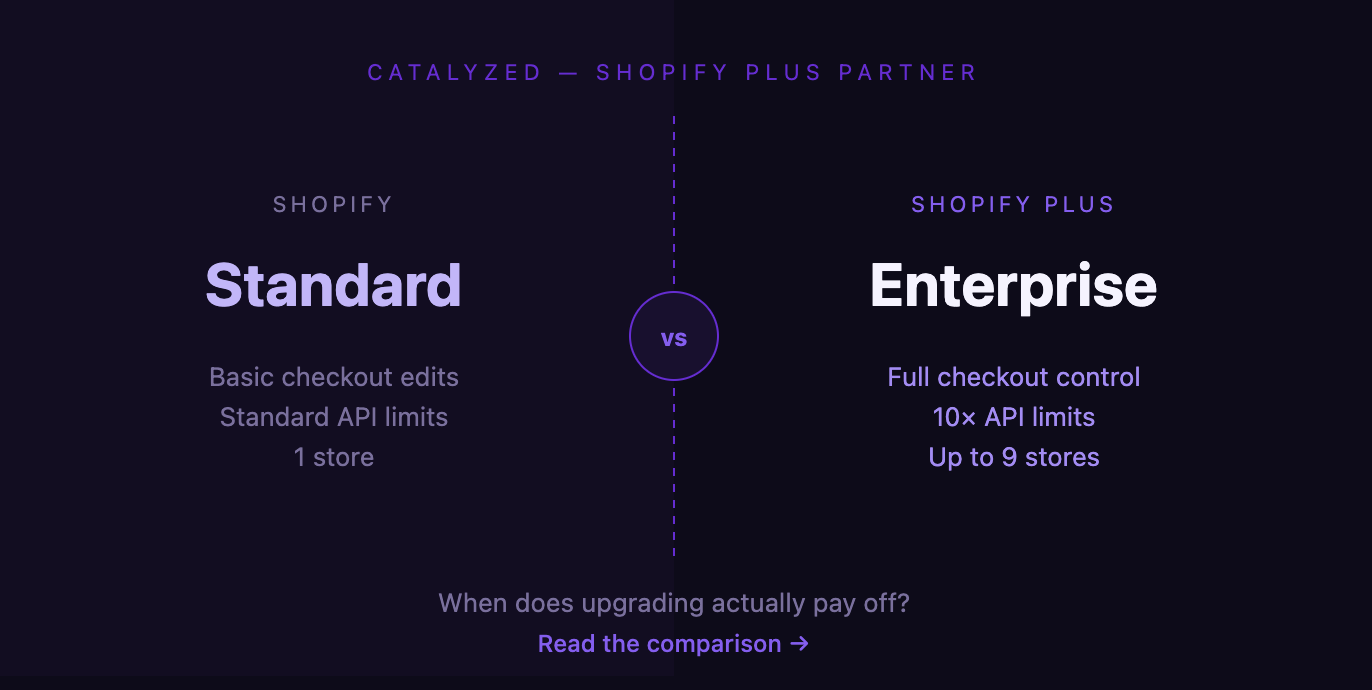
Shopify Plus isn't a different platform. It's the same Shopify you already know, with an enterprise layer on top. The same admin, the same apps, the same checkout foundation. What you get in addition: full control over your checkout, higher technical limits, built-in B2B functionality, multiple stores under one account, and a dedicated contact person at Shopify. It's designed for brands that are hitting the limits of a standard plan and need room to grow.
Shopify positions Plus for brands that are consistently approaching €1 million in annual revenue or are already well beyond that. In practice, most stores seriously consider the switch when they reach around €40,000 to €70,000 in monthly revenue. Not because a specific revenue figure is the magic threshold, but because around that point, you often encounter concrete limitations: a checkout you can't customize, processes you're still doing manually, or integrations that get stuck due to API limits.
If you're still well below that and your store is running smoothly, then a standard plan is almost certainly the smarter choice. More on that later.
This is the biggest and most tangible difference.
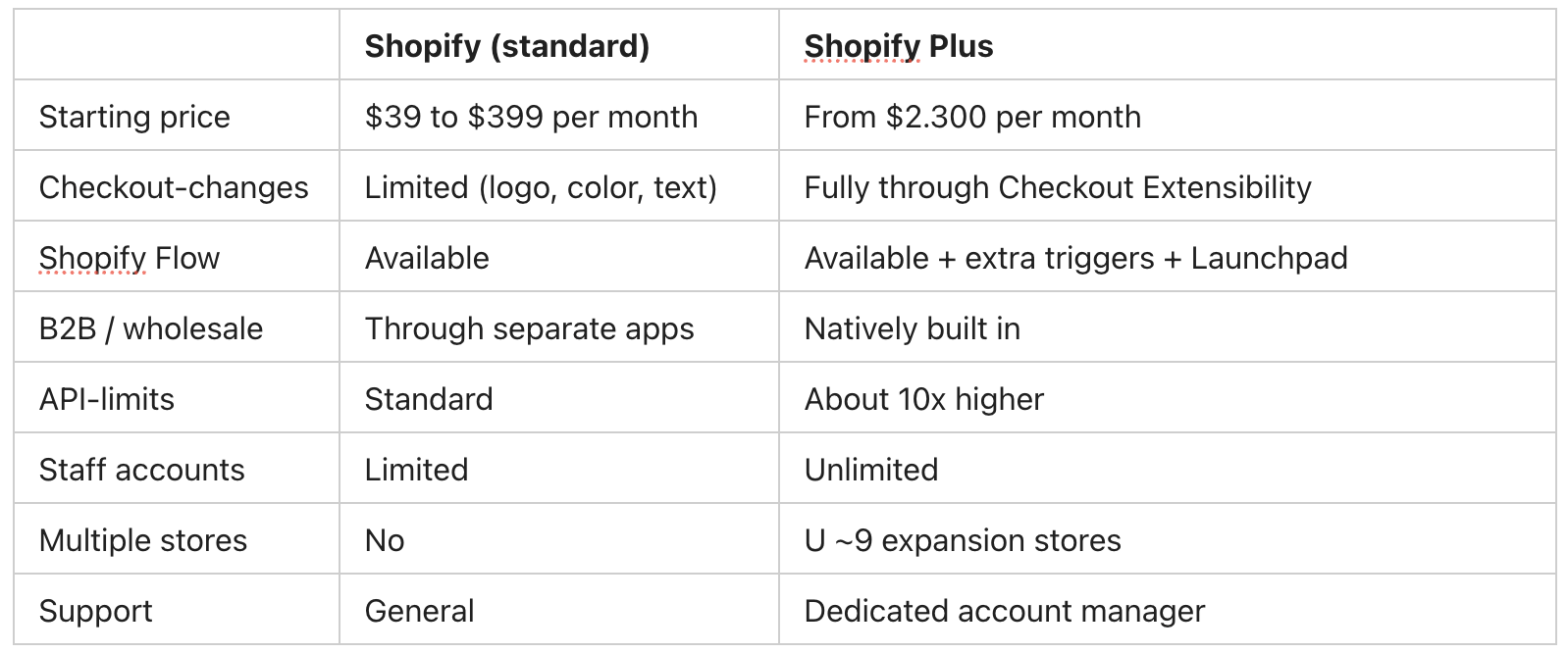
The standard Shopify plans range from Basic (around $39 per month) through Grow (around $105 per month) to Advanced (around $399 per month, $299 with annual payment). For most growing webshops, Advanced is the highest standard plan that makes sense.
Shopify Plus starts at $2,300 per month with a three-year contract, or $2,500 per month with a one-year contract. As soon as your monthly revenue (GMV) exceeds the threshold of approximately $1 million, Shopify switches to a variable model of about 0.25% of your revenue. Please note that these are dollar prices; the exact euro rates may vary slightly.
More importantly, that base amount is your floor, not your ceiling. If you add up your apps, transaction fees, any custom development, and agency support, your total monthly cost in practice often falls between $4,000 and $10,000. For larger volumes, that increases further. So, never calculate with just the entry price.
This is where the real difference lies for most brands, and it's immediately the most important argument for making the switch.
On a standard plan, you can lightly customize your checkout: your logo, your colors, some text. The structure, logic, and flow are fixed. That works perfectly fine for many stores, as the standard Shopify checkout already converts well on its own.
With Plus, you gain access to Checkout Extensibility: the framework that truly allows you to tailor the checkout using UI Extensions, Shopify Functions, and the Branding API. Think of upsells and cross-sells directly in the checkout, dynamic discounts and tiered pricing, custom fields, trust signals in the right place, and separate flows for different customer groups. (The old checkout.liquid method has now been phased out; all checkout customization now runs through Checkout Extensibility.)
For brands serious about conversion optimization, this is the difference between merely decorating a checkout and truly optimizing it. And for most webshops, the greatest conversion gains are found precisely within the checkout and add-to-cart flow.
Shopify Flow lets you automate workflows without code: tagging customers, sending risky orders for manual review, triggering inventory alerts, and more. Flow is now also available on standard plans, so this is no longer an exclusive Plus benefit. What Plus *does* add are extra triggers and actions, particularly around checkout and B2B, plus Launchpad: a tool that lets you schedule flash sales, product launches, and campaigns in advance. This allows you to automatically manage theme changes, price adjustments, and inventory unlocks at the right time.
If you also sell to businesses, this is a huge plus. Shopify Plus has native B2B built-in, at no extra cost: company profiles with multiple buyers, customer-specific pricing and catalogs, payment terms, volume pricing, and a separate B2B checkout. On a standard plan, you'd have to replicate this with separate apps, which is more cumbersome and prone to errors.
The more you integrate (ERP, PIM, custom connections, headless setups), the faster you'll hit API limits. Shopify Plus offers approximately ten times higher API limits than a standard plan. For stores with a complex tech stack or many real-time integrations, this isn't a luxury but a requirement.
Additionally, you get unlimited staff accounts (compared to a fixed maximum on standard plans) and Shopify guarantees 99.99% uptime, even during peak periods like Black Friday.
If you want to scale to multiple countries or brands, Plus offers expansion stores: up to approximately nine additional stores under one account, with extra stores available for an additional fee per store. This allows you to manage different markets, languages, and brands from a single environment instead of separate subscriptions.
On a standard plan, you rely on general Shopify support. Plus brands get a dedicated contact person (Merchant Success Manager) and priority support. For a store where e-commerce is core to the business, this provides speed and certainty.
The features are clear. The question is when they are valuable enough to justify the price difference. These are the signs.
Are your integrations failing? Are you getting error messages on API calls during peak times? Do you need more staff accounts than your plan allows? These are hard limits, not inconveniences. If technology starts to hinder your growth, the business case for Plus is quickly made.
For conversion-focused brands, this is often the decisive reason. On a standard plan, you cannot customize your checkout to the level required for serious CRO. No checkout upsells, no dynamic discount logic, no custom flows per customer group.
And that's precisely where money can be made. A better checkout reduces your cart abandonment and increases your average order value, directly, from the traffic you already have. If you know you're losing revenue in the checkout but your platform doesn't allow you to intervene, Plus often pays for itself through conversion gains alone.
This is exactly the work we do daily at Catalyzed. As a Shopify Plus Partner, we help brands truly leverage that checkout space with structured CRO, instead of just enabling Plus and leaving the default settings. Book a call with us to learn more.
Are you tagging your customers manually? Are you scheduling sales and launches by hand? Do you go through the same repetitive tasks every week? On a larger scale, this doesn't just cost time, but also leads to errors and missed opportunities. Plus's automation layer (more extensive Flow plus Launchpad) pays for itself in hours saved and increased reliability.
Planning to expand into multiple countries, launch a second brand, or start selling B2B? Then expansion stores and native B2B aren't nice-to-haves, but the very reason to switch. Solving this with separate subscriptions and apps quickly becomes more expensive and messier than Plus itself.
Just as important: the switch isn't for everyone.
For now, stick to a standard plan if your store is running smoothly within its current limits, your checkout converts well without customisation, and your monthly revenue is still well below €40,000. In that case, most of your growth won't come from a more expensive platform, but from better utilising what you already have: sharper product pages, improved email flows, and A/B tests on your existing checkout.
Plus is an accelerator for brands that are already hitting limits. It's not a solution for a store that still has room to grow.
Ultimately, the decision boils down to one calculation: do the Plus features generate more revenue than they cost?
Consider a store with €50,000 in monthly revenue and a 2% conversion rate. The difference between Advanced and Plus is roughly $2,000 per month in platform fees, excluding apps and development.
Suppose that with checkout optimisation (only possible on Plus), you increase your conversion from 2% to 2.4%. That's a 20% increase in revenue, or an additional €10,000 per month from the same traffic. In that scenario, the extra cost pays for itself many times over.
Conversely, the logic still holds: if your monthly revenue is €15,000, that same conversion gain has to contend with fixed costs that are relatively much heavier. In that case, the math doesn't (yet) add up.
The trick, therefore, isn't whether Plus is more powerful (it is), but whether your volume and growth plans justify that power. Calculate it with your own figures: your current conversion, your expected conversion gain, and your revenue. That's where the decision lies, not in the feature list.
Shopify Plus is an excellent platform, but it's not a growth strategy in itself. It gives you room: to optimise your checkout, automate processes, scale internationally, and sell B2B. Whether that room yields returns depends on what you do with it.
The brands that get the most out of Plus don't switch because they hit a certain revenue figure, but because they encounter a concrete limitation and know exactly what they're going to build on the other side. This often starts with the checkout, as that's where Plus offers the greatest untapped conversion gains.
Are you unsure if switching is right for your store, or are you already on Plus but your checkout is underperforming? As a Shopify Plus Partner, we'd be happy to help you identify the real conversion opportunities.
→ View our services | → View our case studies | → Schedule an introduction
.jpg)







.png)
.svg)


.png)